Trucking Lab
Florida Truck Parking Study Data

Florida truck parking data built for DOT proposals, freight plans, and corridor-level investment decisions

If your team is still relying on static inventories or outdated assumptions, you are leaving proposal strength on the table. Trucking Lab provides verified Florida truck parking inventory, utilization context, hotspot logic, and proposal-ready analytics so consulting teams can focus on strategy instead of manual data assembly.

DOT proposal support Truck parking inventory Corridor insight Hotspot context Freight consulting

Florida truck parking at a glance

This page combines Trucking Lab inventory logic with publicly discussed freight planning context to help consulting teams quickly assess Florida truck parking supply, corridor pressure, and proposal risk.

287
Private truck parking locations
8,457
Private truck parking spaces
86
Public truck parking locations
3,105
Public truck parking spaces

Facility & Shortage Insights

  • Over 52% of locations are small-format sites (≤15 truck spaces).
  • About 26% are very small sites (≤5 spaces, typically local gas stations or fast-food).
  • Paid parking facilities average ~$24.4 per night.

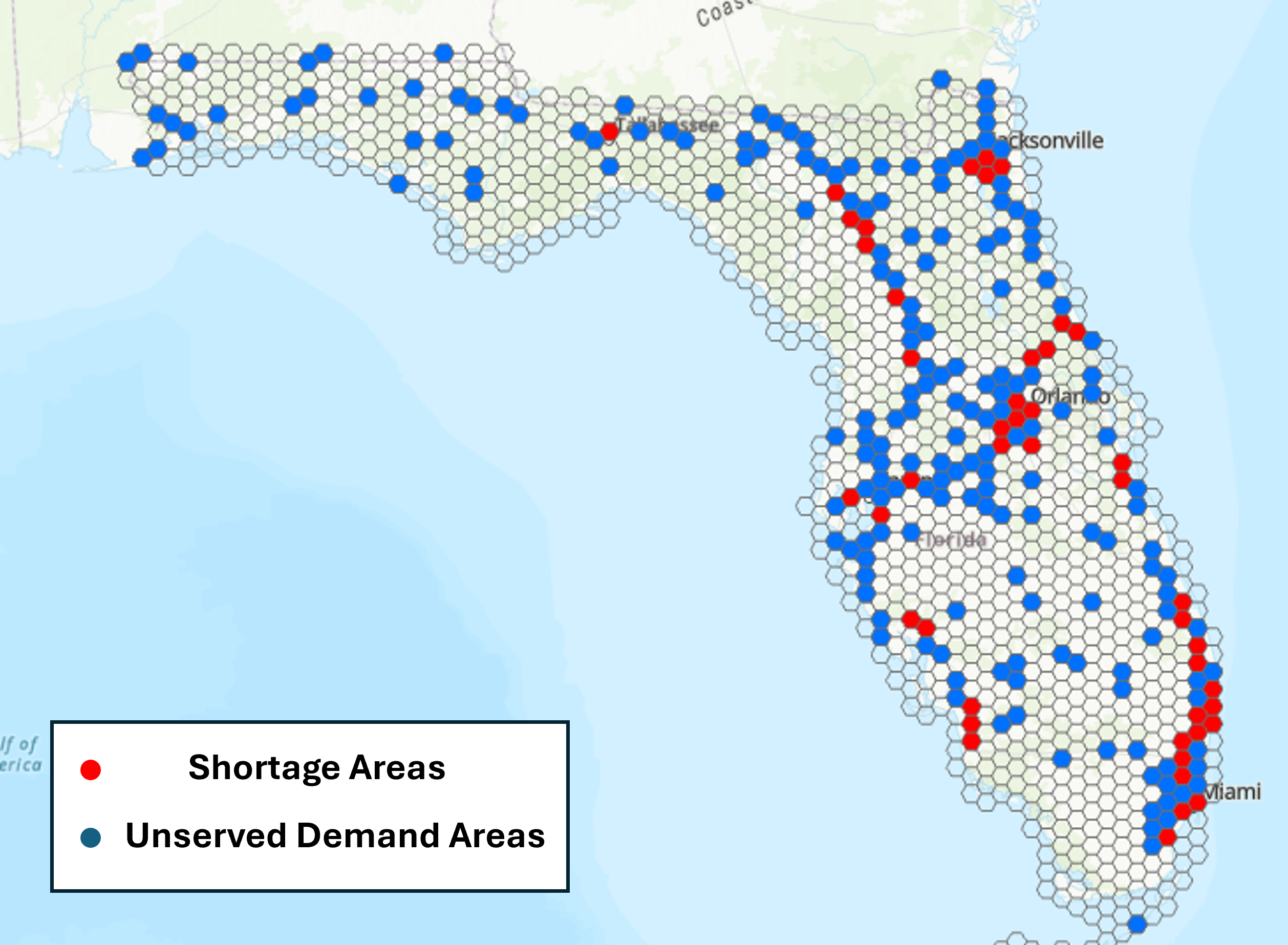
From a grid-based screening (~1,268 hex grids):

  • 100 grids (Red): Already in a shortage (peak availability >90%).
  • 188 grids (Blue): Indicate expected truck parking demand, despite having no official truck parking locations (identified via our demand modeling).
Florida Truck Parking Grid Screening Map

Why Florida matters

Florida has one of the strongest public truck parking footprints in the country, but metropolitan demand and corridor pressure still overwhelm supply in critical areas.

  • State material describes about 300 truck parking locations and notes that public parking makes up a larger share than in most states.
  • Peak demand exceeds 150% in some areas, especially around major urban markets and freight hubs.
  • Unauthorized parking has been identified near Jacksonville, Miami, Orlando, Tampa, and Lakeland, where drivers often park far from their destinations to secure space.

What makes Trucking Lab different

We do not position parking inventory as a static spreadsheet. We frame it as proposal infrastructure. Our role is to help prime consultants move from simple counts to defensible narratives, corridor prioritization, and investment logic.

  • Planning-oriented parking inventory
  • Corridor and hotspot interpretation
  • Proposal-ready framing for DOT work
  • Analytics that plug into study chapters and grant narratives

Why this matters in a competitive DOT proposal

Proposal evaluations are comparative. Your submission is not judged in isolation. If a competing team brings stronger truck parking evidence, better corridor logic, or a more credible unmet-demand story, your team absorbs the risk.

Typical approach

  • Static facility lists with weak screening logic
  • Little distinction between usable truck parking and generic highway-adjacent sites
  • No real bridge between inventory and proposal narrative
  • Limited support for safety, equity, or investment prioritization

With Trucking Lab

  • Verified Florida parking inventory built for freight planning use
  • Corridor and hotspot context to strengthen unmet-demand analysis
  • Clearer linkage between parking supply, operational pressure, and project justification
  • Outputs designed to drop directly into studies, technical memos, and grant support material

What your team gets

The point is not to buy data for data’s sake. The point is to reduce internal labor, strengthen technical credibility, and accelerate proposal execution.

Base Florida data package

  • Truck parking inventory by location
  • Private and public facility classification
  • Truck space counts
  • Amenities and core site attributes
  • Usability logic for planning applications

Proposal-ready outputs

  • GIS-ready dataset
  • Hotspot and corridor context
  • Draft-ready charts and figures
  • Executive-friendly summary language
  • Inputs for demand, pattern, and qualitative extensions

Beyond the base data

Inventory is only Layer 1. For higher-stakes work, Trucking Lab also supports demand logic, parking pattern interpretation, and proposal-strength narrative framing. That is where the real strategic advantage begins.

  • Truck Parking Demand Model
  • Parking Patterns Analysis
  • Qualitative Insight for safety and equity framing
  • EV Truck Charging Suitability analysis

Built for consulting teams

  • Freight plan teams
  • DOT truck parking study teams
  • MPO and corridor study teams
  • Grant strategy and infrastructure advisory teams
  • Prime consultants seeking a technical edge

Methodology note

Truck parking counts can vary across sources because not all facilities serve as practical overnight parking, and not all inventories use the same inclusion rules. Trucking Lab is designed for freight planning and proposal use, which means the emphasis is not just on counting places near highways, but on identifying usable truck parking supply in a way that supports defensible analysis.

For Florida specifically, older public inventories and Trucking Lab counts should be interpreted as complementary, not contradictory. One reflects broader planning context, while the other reflects updated planning-oriented inventory logic and proposal application.

Frequently asked questions

How many truck parking spaces are in Florida?

Trucking Lab inventory for Florida includes 8,457 private spaces across 287 private locations and 3,105 public spaces across 86 public locations.

Where are major pressure areas in Florida?

Florida planning material points to Jacksonville, Miami, Orlando, Tampa, Lakeland, and major interstate corridors as leading truck parking pressure areas.

What is the main truck parking issue in Florida?

Florida's main issue is heavy metropolitan and corridor overcrowding, with some areas experiencing demand above 150% during peak periods and recurring unauthorized parking.

Why do truck parking counts differ across sources?

Because different datasets include different facility types. Some sources include fuel stations or highway-adjacent locations that are not practical overnight truck parking. Trucking Lab applies planning-oriented screening so the output is more useful for consulting and public-sector analysis.

Who should use this Florida truck parking page?

Freight consulting firms, DOT proposal teams, corridor study teams, MPO planners, and infrastructure strategy teams that need stronger parking evidence, better corridor logic, and ready-to-use analysis support.