Trucking Lab
Virginia Truck Parking Study Data

Virginia truck parking data for stronger DOT proposals

Get verified inventory, shortage screening, corridor context, and proposal-ready outputs without rebuilding the analysis from scratch.

Why it matters: Better parking evidence makes unmet demand and investment priorities easier to defend.

DOT proposal support Parking inventory Shortage screening Corridor analysis

Virginia parking, at a glance

181
Private parking locations
7,576
Private parking spaces
36
Public parking locations
802
Public parking spaces
3,244 spaces short today, 8,574 by 2045

The 2022 study puts current need at about 3,244 additional spaces, rising to 8,574 by 2045. I-81 and I-95 alone account for 64% of statewide need, and Staunton, Richmond, and Bristol hold 13 of the top 20 hotspots.

Small facilities dominate the inventory

  • More than 51% of locations have 15 or fewer truck spaces.
  • About 23% have five or fewer spaces.
  • Paid facilities average approximately $20.00 per night.

Grid screening across approximately 761 hexagons:
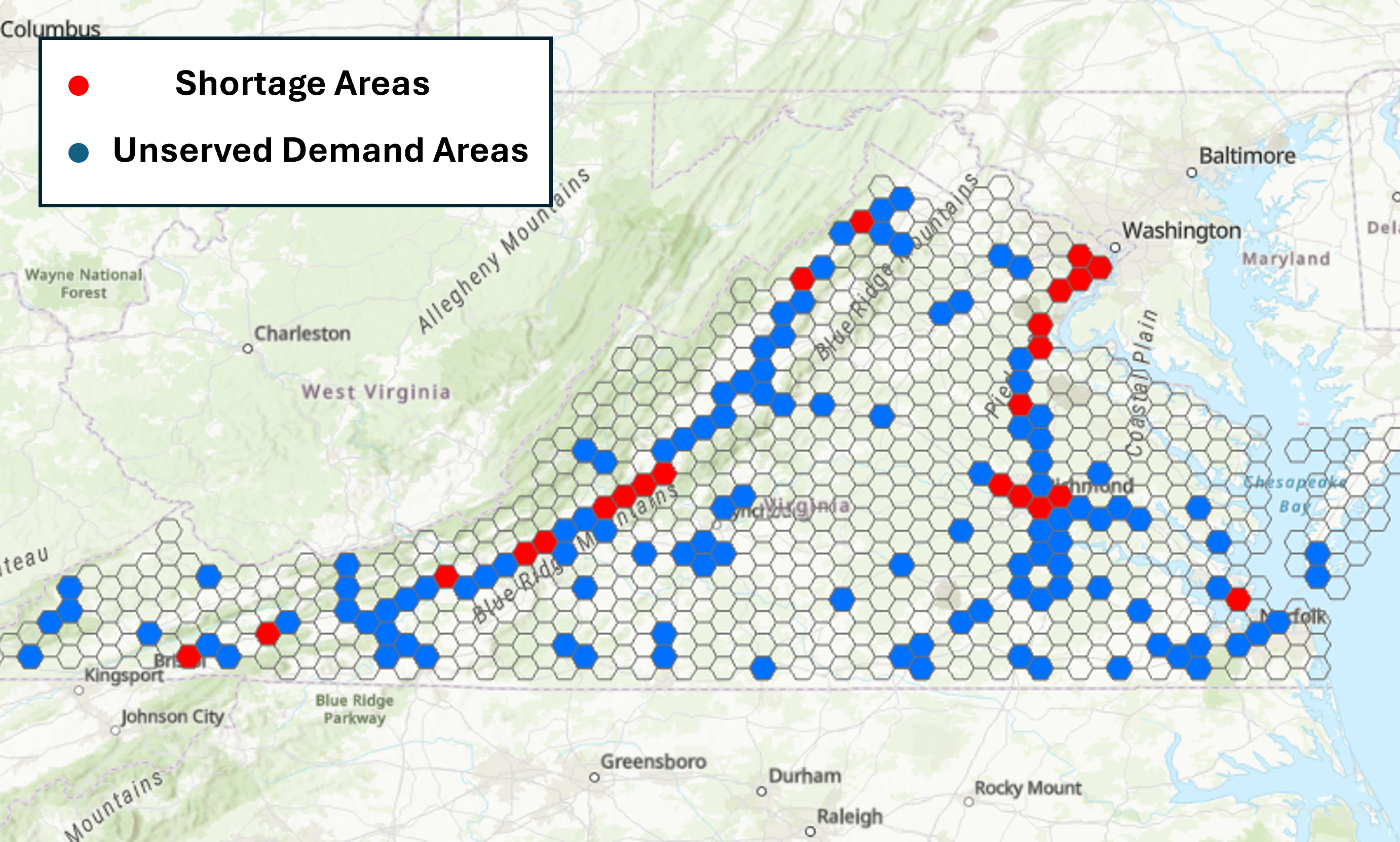
  • 58 shortage grids: peak utilization exceeds 90%.
  • 114 demand grids: modeled demand exists without an official parking location.
Virginia truck parking shortage and demand screening map

Why this matters in a competitive DOT proposal

Typical approach

  • Unscreened facility lists
  • No distinction between usable and incidental parking
  • Weak connection to the proposal narrative
  • Limited support for investment prioritization

With Trucking Lab

  • Planning-ready Virginia inventory
  • Shortage and utilization context
  • Clear corridor and project logic
  • Outputs ready for technical documents

Counts describe supply. Context explains the need.

Virginia's shortage is already fully quantified. Repeating totals is not enough — show how the I-81 and I-95 deficits differ and how capacity should be staged against a growing gap.

What you get

Base Virginia data

  • Parking inventory by location
  • Public and private classification
  • Truck-space counts and amenities
  • Planning-use screening

Proposal-ready outputs

  • GIS-ready dataset
  • Hotspot and corridor context
  • Draft-ready charts and figures
  • Executive summary language

Deeper analysis

  • Truck parking demand model
  • Parking patterns analysis
  • Safety and equity framing
  • EV truck-charging suitability

Built for consulting teams

  • Freight plan teams
  • DOT truck parking study teams
  • MPO and corridor study teams
  • Grant and infrastructure advisers

Reality check

Counts differ across sources because inclusion rules differ. Public totals and Trucking Lab numbers are complementary — one gives statewide context, the other gives usable supply.

Common questions

How many truck parking spaces are in Virginia?

Trucking Lab includes 7,576 private truck parking spaces across 181 locations and 802 public spaces across 36 locations.

Where is pressure concentrated?

Virginia planning material points to I-81, I-95, Staunton, Richmond, Bristol, and the major statewide freight network.

What is the main truck parking issue in Virginia?

A large quantified deficit concentrated on I-81 and I-95, with hotspot regions already identified and future need projected to grow sharply.

Why do truck parking counts differ across sources?

Counts differ because datasets apply different facility definitions and inclusion rules. Public totals provide statewide context, while Trucking Lab numbers focus on usable parking supply.

Need Virginia truck parking data now?

Tell us about the proposal or study. We will help you move from parking inventory to a defensible investment story.