
Where Is Truck Parking Under the Most Pressure?
A practical screening tool for states, MPOs, and corridor studies to identify where field checks and parking improvements should begin.
National Coverage · State · MPO · CorridorKey Takeaways
View One-Page Technical Brief- Start with the full network: Find the locations where parking pressure deserves a closer look.
- The busiest highway is not always the biggest parking problem: Some busy corridors have enough parking. Others do not.
- Get a priority list: Focus field checks and parking studies where they are most needed.
The National Screen in Three Numbers
Screening cells covering the 48 contiguous states.
Cells with at least one identified truck parking facility.
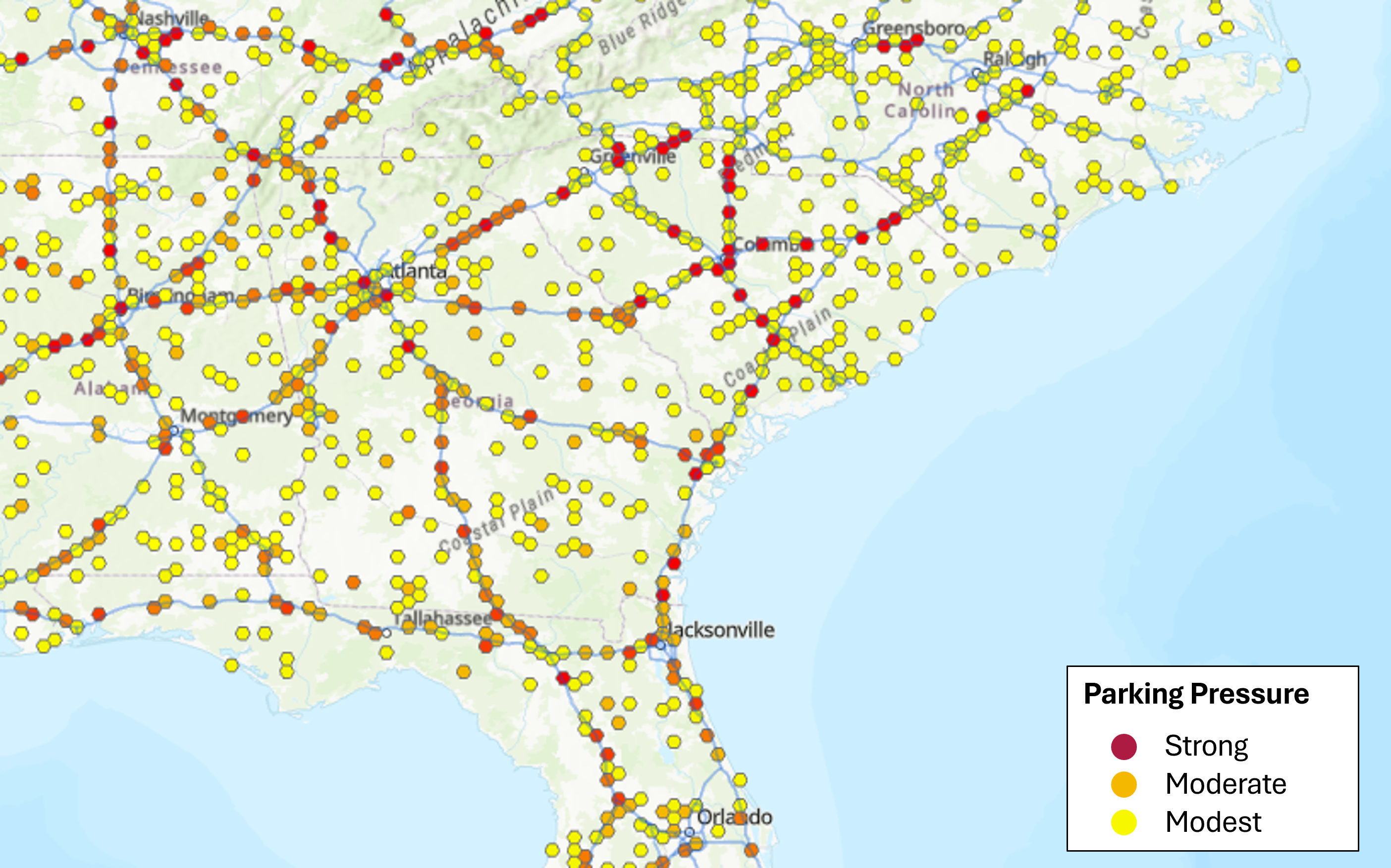
Parking-pressure locations flagged for additional review.
See Where Parking Pressure Appears
What the Screen Tells You
A simple way to find where to look first.
The screen highlights locations where truck traffic and parking use suggest existing supply may be under pressure.
- Traffic alone is not enough. A busy corridor may already have enough parking.
- Parking use matters. Heavily used locations deserve a closer look.
- Amenities matter. Food service is strongly associated with where parking activity concentrates.
From Statewide Map to Field Action
Screen the Area
Identify the corridors and locations that stand out.
Verify Priority Locations
Check ramps, shoulders, nearby streets, rest areas, and truck stops.
Choose the Response
Evaluate added capacity, operational changes, parking information, or further site study.
A Location Is Flagged. What Next?
- Confirm the problem: Check for overflow on ramps, shoulders, streets, or nearby properties.
- Check existing facilities: Determine whether they are full, difficult to access, or poorly configured.
- Evaluate options: Consider expansion, new spaces, operational improvements, or better parking information.
What the Map Does Not Tell You
This is a screening tool, not a final space count. A flagged location does not tell you exactly how many spaces are needed.
Local verification is still needed. Field observations and local data should confirm conditions at specific locations.
Data confidence varies. Some locations have more direct observations than others.
What a State, MPO, or Corridor Analysis Can Deliver
- Truck parking pressure map for a state, MPO, region, or corridor
- Ranked locations for field verification
- Interstate and freight-corridor summaries for planning and project screening
Start With Where to Look
Parking Pressure Screening identifies where to investigate first, so detailed field work can focus on the locations that matter most.